
PRP Therapy for Shoulder Pain: The Shoulder Anatomy-to-Outcome Framework That Matches Your Exact Diagnosis to the Right Protocol in 2026
PRP Therapy for Shoulder Pain: The Shoulder Anatomy-to-Outcome Framework That Matches Your Exact Diagnosis to the Right Protocol in 2026
Introduction: Why Shoulder Pain Is So Hard to Treat, and Why PRP Is Changing That
Shoulder pain is one of the most common and most frustrating complaints in musculoskeletal medicine. It affects between 7% and 26% of the general population, and large population studies rank shoulder disorders as the third most common musculoskeletal complaint. Within orthopedic practice, rotator cuff tendinopathies and impingement syndrome alone account for up to 70% of all shoulder pain.
For decades, the treatment path has looked the same: rest, NSAIDs, physical therapy, a corticosteroid injection, and surgery when all else fails. The problem is that this ladder often manages symptoms without addressing the underlying biological deficit that caused the pain in the first place. Corticosteroids quiet inflammation temporarily but carry real long-term risks. Surgery is invasive and not always necessary.
This is where platelet-rich plasma (PRP) therapy enters the picture. The central premise of this article is straightforward but important: PRP therapy for shoulder pain is not a one-size-fits-all treatment. It is a precision-matched biological intervention whose success depends on understanding shoulder anatomy, the specific diagnosis, and the right protocol matched to that diagnosis.
The framework that follows moves logically from anatomy to diagnosis to mechanism to protocol to outcomes, and finally to how Unicorn Bioscience applies this framework clinically. The evidence base is now robust. A November 2025 meta-analysis of 36 randomized controlled trials involving roughly 2,000 patients and a 2024 meta-analysis of 14 RCTs for frozen shoulder confirm that PRP is supported by a mature clinical literature.
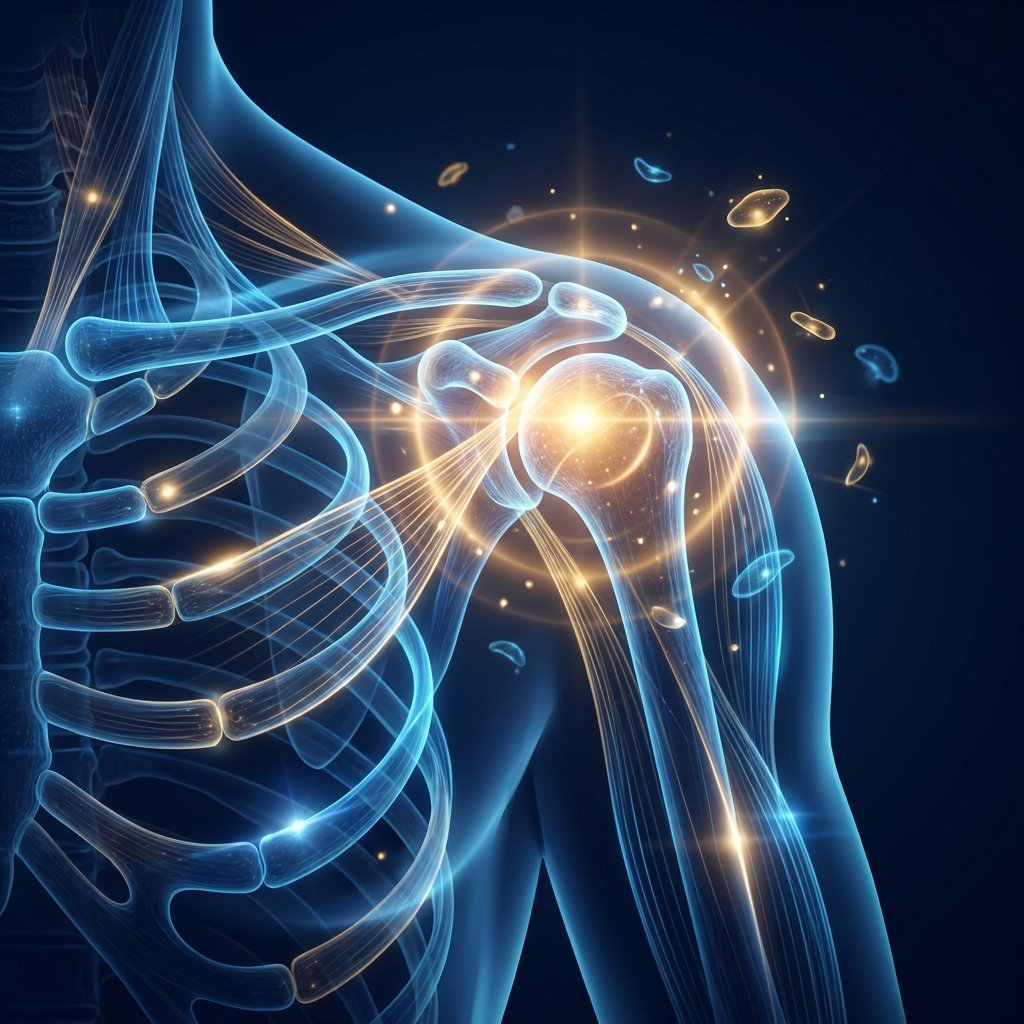
The Shoulder Anatomy Framework: Why Certain Structures Fail and Why PRP Targets Them Precisely
The shoulder is the most mobile joint in the human body. That mobility comes at the cost of structural vulnerability. The same anatomy that allows the arm to rotate through enormous ranges of motion also leaves key tissues exposed to chronic stress and degeneration.
Several structures matter most in the context of PRP treatment:
- The rotator cuff (supraspinatus, infraspinatus, teres minor, and subscapularis)
- The subacromial space, where the cuff and bursa sit beneath the acromion
- The glenohumeral joint capsule, which becomes thickened and contracted in frozen shoulder
- The long head of the biceps tendon
- The glenoid labrum
At the center of most rotator cuff problems is the critical zone, an avascular watershed region of the supraspinatus tendon located approximately 1 cm from its insertion on the greater tuberosity. This is the single most common site of rotator cuff degeneration and tearing.
The biological reason is straightforward. The critical zone has poor intrinsic blood supply, meaning it receives minimal oxygen and nutrients. After micro-trauma, healing is chronically impaired because the tissue cannot mount an effective repair response.
This is precisely where PRP’s mechanism becomes relevant. PRP delivers angiogenic growth factors, specifically VEGF (vascular endothelial growth factor) and PDGF (platelet-derived growth factor), that directly stimulate new blood vessel formation in this hypovascular zone. This is not a generic anti-inflammatory effect; it is a targeted biological repair of the precise structural deficiency that makes the rotator cuff uniquely prone to chronic degeneration.
Other shoulder structures have their own anatomical vulnerabilities. The joint capsule in frozen shoulder, the biceps tendon, and the glenohumeral cartilage each respond to PRP through different growth factor pathways, covered in the diagnosis-specific sections below.
How PRP Works: The Biological Mechanism Behind the Healing
PRP is a concentration of the patient’s own platelets, prepared from a small blood draw and processed to achieve a supraphysiological platelet concentration. When those platelets are activated at the injury site, they release a powerful payload of growth factors: PDGF, TGF-β, VEGF, IGF, EGF, FGF, and HGF.
These growth factors drive four key biological actions:
- Cellular proliferation: stimulating tenocyte and fibroblast activity
- Collagen synthesis: rebuilding the extracellular matrix of tendons and capsule
- Angiogenesis: forming new blood vessels in the critical zone
- Extracellular matrix remodeling: restoring healthy tissue architecture
PRP also has an important anti-inflammatory dimension. It decreases the pro-inflammatory cytokines IL-1β and TNF-α and promotes a shift in macrophage phenotype from the inflammatory M1 state to the tissue-repair M2 state. This is why PRP tends to provide durable relief rather than temporary suppression of symptoms.
One variable matters more than almost any other: platelet concentration. In a landmark 2025 meta-analysis of 1,995 patients, high-platelet PRP (greater than 1,000,000 platelets/µL) achieved clinically meaningful improvement at every follow-up timepoint, while low-platelet PRP failed to deliver meaningful pain relief. Concentration is not a marketing detail; it is a quality threshold that separates effective treatment from disappointing results.
Because PRP is autologous, derived entirely from the patient’s own blood, there is no risk of foreign-substance reactions. This stands in sharp contrast to corticosteroids. Repeated cortisone injections increase tendon rupture risk by two to three times and cause cartilage thinning and bone loss. The 2025 AAOS guidelines now recommend only a single corticosteroid injection for rotator cuff injuries, creating a clinical gap that PRP is well-positioned to fill.
The LP-PRP vs. LR-PRP Distinction: Why Formulation Matters for Shoulder Injections
Not all PRP is the same. One of the most important classifications is based on leukocyte (white blood cell) content: leukocyte-rich PRP (LR-PRP) and leukocyte-poor PRP (LP-PRP).
LR-PRP contains higher concentrations of neutrophils and monocytes. When injected into a joint space, these cells can trigger more severe acute inflammatory responses and increased synovial cell death. LP-PRP, by contrast, carries a lower leukocyte load while still delivering the full growth factor payload.
For intra-articular shoulder injections (the glenohumeral joint and the subacromial bursa), LP-PRP is generally preferred. The joint environment is sensitive to inflammatory mediators, and LP-PRP reduces the risk of a post-injection flare. For tendon injections such as the rotator cuff or biceps tendon, the leukocyte preference may differ and remains an area of ongoing clinical refinement.
PRP classification also includes fibrin architecture (pure PRP versus leukocyte-fibrin-rich PRP), and preparation method, centrifugation speed, and activation technique all influence the final product. The LP-PRP versus LR-PRP distinction is not a detail every provider addresses, but it is a meaningful variable in shoulder-specific outcomes, and one that Unicorn Bioscience’s protocol accounts for.
The Shoulder Anatomy-to-Outcome Framework: Matching the Diagnosis to the Right PRP Protocol
Different shoulder diagnoses have different anatomical targets, different biological needs, and different expected outcome timelines. The protocol should be matched accordingly. PRP has demonstrated clinical evidence across six primary shoulder conditions, each addressed below.
Rotator Cuff Tendinopathy and Partial-Thickness Tears
Rotator cuff tendinopathy involves degenerative changes within the tendon tissue, while partial-thickness tears represent structural disruption of less than the full tendon width. Both are concentrated in the critical zone. For a detailed look at how tear thickness affects treatment decisions, see our guide on rotator cuff tear PRP treatment by thickness.
The November 2025 meta-analysis of 36 RCTs demonstrated significant pain reduction at 6 weeks, 3 months, 6 months, and 12 months following PRP injection. The 2025 Alshahir meta-analysis found PRP superior in ASES functional scores at 12 weeks (MD 13.24, p=0.03) and 24 weeks (MD 11.23, p=0.05), with Constant-Murley scores significantly superior at 24 weeks (MD 9.85, p=0.002).
An important expectation-setting point: corticosteroids outperform PRP in the short term (weeks 1 to 6), but PRP produces significantly superior long-term outcomes. Combination therapy is also notable; PRP plus hyaluronic acid was found superior to PRP alone, HA alone, or corticosteroids for partial rotator cuff tears.
- Typical protocol: 1 to 3 injections spaced 1 to 3 weeks apart, ultrasound-guided to the critical zone, combined with structured physical therapy
- Outcome timeline: initial response at 4 to 6 weeks, meaningful functional improvement at 3 to 6 months
Frozen Shoulder (Adhesive Capsulitis)
Adhesive capsulitis is characterized by progressive fibrosis and contracture of the glenohumeral joint capsule, causing severe pain and loss of range of motion across all planes. PRP is injected into the glenohumeral joint capsule and/or the rotator interval, the region of capsule between the supraspinatus and subscapularis tendons most affected in early-stage frozen shoulder. Learn more about our dedicated frozen shoulder PRP injection protocol.
The 2024 meta-analysis of 14 RCTs (1,024 patients) showed PRP had significant advantages over control groups in VAS pain scores, UCLA scores, DASH scores, SPADI scores, and active and passive range of motion in all planes. A prospective cohort study of 305 patients found a mean pain reduction of 64.57% after PRP treatment, with 87.5% of cases achieving 50% or greater improvement.
PRP has been identified as most effective for adhesive capsulitis among all shoulder conditions reviewed. The rationale is that PRP’s TGF-β modulation and anti-fibrotic effects may help interrupt the fibrotic cascade driving capsular contracture, while VEGF supports tissue remodeling. LP-PRP is preferred given the intra-articular target.
- Outcome timeline: pain reduction often begins within 2 to 4 weeks; range of motion improvements typically progress over 6 to 12 weeks
Shoulder Impingement Syndrome (Subacromial Impingement)
Impingement syndrome occurs when the supraspinatus tendon and subacromial bursa are compressed between the humeral head and the acromion during arm elevation, causing pain and progressive tendon damage. It accounts for 44% to 65% of shoulder pain diagnoses in general practice.
PRP is delivered to the subacromial space and/or the affected tendon under ultrasound guidance. A dedicated study found that a single PRP injection resulted in significant decreases in VAS pain scores and QuickDASH scores, along with improved range of motion. The subacromial bursa is a site of chronic low-grade inflammation, and PRP’s macrophage phenotype-switching effect (M1 to M2) addresses the inflammatory driver while growth factors support tendon repair.
Ultrasound guidance is especially important here because the subacromial space is narrow and blind injection accuracy is significantly lower.
- Outcome timeline: functional improvement typically begins at 4 to 8 weeks, with continued progress over 3 to 6 months
Biceps Tendinopathy (Proximal Biceps Tendinitis)
Proximal biceps tendinopathy involves degeneration or inflammation of the long head of the biceps tendon at its origin on the supraglenoid tubercle and within the bicipital groove. The tendon’s course through the groove and into the glenohumeral joint makes precise injection targeting critical. Our biceps tendonitis PRP injection page covers the full treatment approach for this condition.
PRP has been shown to outperform prolotherapy long-term for proximal biceps tendinitis, and the condition is consistently included in the PRP-treatable shoulder spectrum. PDGF and TGF-β drive tenocyte proliferation and collagen remodeling in the degenerated tissue. Ultrasound guidance is essential for accurate bicipital groove injection.
- Outcome timeline: 4 to 8 weeks for initial pain relief, 3 to 6 months for functional restoration
Glenohumeral Osteoarthritis (Shoulder Joint OA)
Glenohumeral osteoarthritis involves progressive cartilage loss within the ball-and-socket joint, causing pain, stiffness, and reduced range of motion. In early-to-moderate disease, intra-articular PRP delivers growth factors that support chondrocyte activity, reduce synovial inflammation, and may slow cartilage degradation.
LP-PRP is strongly preferred for intra-articular glenohumeral injections to minimize post-injection inflammatory flare. PRP plus hyaluronic acid has shown superior outcomes to either agent alone, providing both biological repair stimulation and mechanical lubrication. For patients considering their options, our hyaluronic acid injection frequency guide provides useful context on combination approaches. PRP is most effective for early-to-moderate OA; advanced disease with severe cartilage loss has a more limited response.
- Outcome timeline: symptomatic relief typically begins at 4 to 6 weeks; functional improvement progresses over 3 to 6 months, with possible repeat injections
Post-Surgical Shoulder Recovery: PRP as a Repair Augmentation Tool
PRP is increasingly used alongside rotator cuff repair surgery to enhance healing. The November 2025 meta-analysis found retear rates after surgical repair of 16.5% with PRP versus 23.6% without (P=0.002), a clinically significant reduction.
A March 2026 Scientific Reports study found PRP after shoulder surgery was associated with shorter wound healing time, improved postoperative pain and functional outcomes, shorter hospitalization, and higher patient satisfaction, with the largest benefits observed in the rotator cuff repair cohort. PRP’s growth factors accelerate tendon-to-bone healing at the repair site, supporting the biological integration that determines long-term durability. PRP can therefore serve both as a surgery-avoidance strategy and as a surgical recovery enhancement tool.
Who Is a Good Candidate for Shoulder PRP? Patient Selection Criteria
PRP outcomes are significantly influenced by patient selection. Not every shoulder condition or patient profile responds equally.
Favorable candidates generally include those with partial-thickness rotator cuff tears (rather than full-thickness), early-to-moderate adhesive capsulitis, impingement syndrome without complete tendon rupture, early glenohumeral OA, biceps tendinopathy, and patients who have not responded adequately to conservative care such as physical therapy and NSAIDs.
Chronicity matters. PRP is generally well-suited for chronic tendinopathies where the normal healing response has stalled. The platelet concentration factor remains a key quality variable, so patients should ask providers about their centrifugation protocol and whether they target greater than 1,000,000 platelets/µL.
Protocol design may be influenced by patient age, inflammation levels, prior treatment history (especially prior corticosteroid injections), current medications such as anticoagulants and NSAIDs, and personal health goals.
PRP has limited evidence or is not the primary recommendation for complete full-thickness rotator cuff tears requiring surgical repair, severe glenohumeral OA with bone-on-bone changes, or acute traumatic injuries requiring structural intervention. A thorough clinical evaluation, including imaging, is essential before determining candidacy.
The Precision Injection Protocol: Why Ultrasound Guidance Is Non-Negotiable for Shoulder PRP
Accuracy is essential. Blind, landmark-guided shoulder injections achieve only 72.5% accuracy, while ultrasound-guided injections achieve 92.5% accuracy (P=0.02). That difference is both statistically and clinically significant.
The shoulder’s complex anatomy makes accurate needle placement exceptionally difficult without real-time imaging. The narrow subacromial space, the deep glenohumeral joint, the bicipital groove, and the rotator interval all demand precision. Ultrasound guidance enables real-time tendon visualization, subacromial space tracking, glenohumeral joint depth navigation, and peppering monitoring (distributing PRP through the target tissue).
Safety is the other critical dimension. Serious complication rates are less than 0.1% with ultrasound-guided neurovascular avoidance. The shoulder contains critical neurovascular structures, including the brachial plexus, axillary nerve, and axillary artery, that must be identified and avoided.
An emerging technology is also worth noting. AI-navigated ultrasound guidance uses deep learning of shoulder ultrasound images to construct precise anatomical models and improve injection path planning, representing the next frontier in precision delivery. Our precision-guided regenerative injection approach incorporates these advances to maximize accuracy and safety.
At Unicorn Bioscience, all injections are administered using advanced imaging guidance, including ultrasound technology, ensuring accurate delivery to the targeted anatomical structure. The entire procedure takes less than one hour, is performed as an outpatient under local anesthesia, and qualified patients can receive treatment the same day as their consultation.
PRP vs. Corticosteroids vs. Surgery: Understanding the Options in 2026
This is best understood as a clinical decision-making guide, not a binary choice.
- Corticosteroids offer faster short-term pain relief (weeks 1 to 6) but carry real risks: a two to three times increase in tendon rupture risk with repeated injections, cartilage thinning, and bone loss. The 2025 AAOS guidelines now limit the recommendation to a single injection for rotator cuff injuries.
- PRP has a slower initial onset but significantly superior long-term outcomes at 6, 12, and 24 months. It causes no tendon weakening and no cartilage damage, and as an autologous treatment it carries a minimal side effect profile, typically temporary soreness resolving within days.
- Surgery is appropriate for complete full-thickness tears, structural instability, or cases where conservative and regenerative treatments have failed. PRP can augment surgical outcomes when surgery is necessary. For patients weighing their options, our stem cell vs. surgery recovery comparison offers additional perspective on non-surgical pathways.
Combination approaches are increasingly important. PRP plus physical therapy is more effective than physical therapy alone, and PRP plus hyaluronic acid outperforms either agent alone for partial rotator cuff tears and joint conditions. The 2025 AAOS restriction on repeat corticosteroid injections creates a meaningful treatment gap that PRP is clinically positioned to fill.
The decision framework, in summary: corticosteroids for acute short-term relief when needed (once); PRP for durable long-term repair and function; surgery when structural integrity requires it, with PRP potentially augmenting recovery.
What to Expect: The PRP Treatment Experience at Unicorn Bioscience
Initial consultation. The process begins with a comprehensive evaluation, including review of imaging (MRI, ultrasound), assessment of diagnosis and chronicity, prior treatments, and individual patient factors such as age, inflammation levels, medications, and health goals. Virtual and in-person consultations are available.
Treatment planning. A personalized protocol is developed, covering the number of injections (typically 1 to 3 spaced 1 to 3 weeks apart), PRP formulation selection (LP-PRP versus LR-PRP based on the injection target), and whether combination therapy such as PRP plus hyaluronic acid or PRP plus physical therapy is appropriate.
The procedure. A small blood draw is taken and centrifuged to prepare high-concentration PRP targeting greater than 1,000,000 platelets/µL. The PRP is delivered by ultrasound-guided injection to the precise anatomical target, with the entire outpatient procedure taking under one hour. For a full walkthrough of what this involves, see our PRP injection procedure step-by-step guide.
Post-procedure. Patients may experience temporary soreness at the injection site that resolves within days. There is no tendon weakening or infection risk associated with corticosteroids. Structured physical therapy integration is recommended.
Outcome timelines vary by condition: impingement (4 to 8 weeks initial response), frozen shoulder (2 to 4 weeks for pain, 6 to 12 weeks for range of motion), rotator cuff tendinopathy (4 to 6 weeks initial, 3 to 6 months functional), and glenohumeral OA (4 to 6 weeks symptomatic). Outcomes are typically assessed at 6 and 12 weeks, with additional injections considered based on clinical response.
Unicorn Bioscience operates 8 locations across Texas, Florida, and New York, making precision shoulder PRP accessible across multiple major markets.
Frequently Asked Questions About PRP Therapy for Shoulder Pain
How many PRP injections will I need for my shoulder?
Typically 1 to 3, spaced 1 to 3 weeks apart, depending on diagnosis and severity.
Is PRP painful?
The injection itself involves local anesthesia. Post-procedure soreness is temporary and resolves within days.
How long before results are noticeable?
This varies by condition. Initial relief often begins at 4 to 8 weeks, with continued improvement over 3 to 6 months.
Is PRP safe?
Yes. Because it is autologous, there is no foreign-substance risk. The serious complication rate is less than 0.1% with ultrasound-guided technique, and there are none of the tendon rupture or cartilage damage risks associated with corticosteroids.
Can PRP help after a corticosteroid injection?
Yes. PRP is often used as a next-line treatment after corticosteroid options are exhausted, particularly given the 2025 AAOS single-injection guideline.
What is the difference between LP-PRP and LR-PRP, and which will be used?
LP-PRP is generally preferred for intra-articular shoulder injections. Unicorn Bioscience’s protocol accounts for this distinction based on the specific injection target.
Can PRP help if surgery has been recommended?
PRP may be an appropriate non-surgical alternative for many conditions. For those who do proceed to surgery, PRP can augment healing and reduce retear rates.
Is PRP FDA-approved for shoulder conditions?
As of 2026, the FDA has not approved PRP specifically for orthopedic conditions, but substantial clinical evidence supports its safety and efficacy when administered by qualified providers within FDA regulatory frameworks.
Conclusion: The Right Diagnosis, the Right Protocol, the Right Outcome
PRP therapy for shoulder pain is not a single treatment but a precision-matched biological intervention. Its success depends on understanding the exact diagnosis, the relevant shoulder anatomy, the appropriate PRP formulation, and the delivery precision of ultrasound guidance.
The evidence landscape has matured considerably. From the November 2025 meta-analysis of 36 RCTs showing sustained pain reduction across 12 months for rotator cuff tears, to the 2024 meta-analysis of 14 RCTs demonstrating PRP’s superiority for frozen shoulder across all outcome measures, the clinical literature now supports confident application.
The factors that determine outcomes are clear: platelet concentration greater than 1,000,000 platelets/µL, the correct PRP formulation (LP-PRP for intra-articular use), ultrasound-guided delivery (92.5% versus 72.5% accuracy), and condition-matched protocols. Unicorn Bioscience applies this full framework through precision imaging guidance, personalized protocol design, high-quality PRP preparation, and experienced clinical oversight across 8 locations.
Shoulder pain does not have to lead inevitably to surgery or indefinite corticosteroid dependence. For many patients, PRP offers a durable, biologically sound path to recovery that addresses the root cause of the problem rather than masking symptoms.
Ready to Find Out If PRP Is Right for Your Shoulder? Start With a Consultation at Unicorn Bioscience
If shoulder pain is limiting daily life, the next step is a personalized evaluation. Unicorn Bioscience invites patients to schedule a regenerative medicine consultation online, virtual or in-person, at any of its 8 locations across Texas (Austin, Dallas, El Paso, Fort Worth, Houston, and San Antonio), Florida (Boca Raton), and New York (Manhattan).
Qualified candidates can receive their PRP injection the same day as their consultation. Every patient receives a comprehensive assessment of their specific diagnosis, imaging, prior treatment history, and health goals before a protocol is recommended.
To get started, call (737) 347-0446 or visit unicornbioscience.com.
Unicorn Bioscience’s team, including physician assistants trained at Johns Hopkins, brings the clinical expertise and precision technology to match each patient’s exact shoulder diagnosis to the protocol most likely to deliver lasting results.
Schedule Your Consultation Today!