Stem Cell Injection Recovery Time: The 72-Hour vs. 12-Month Reality Check
Stem Cell Injection Recovery Time: The 72-Hour vs. 12-Month Reality Check
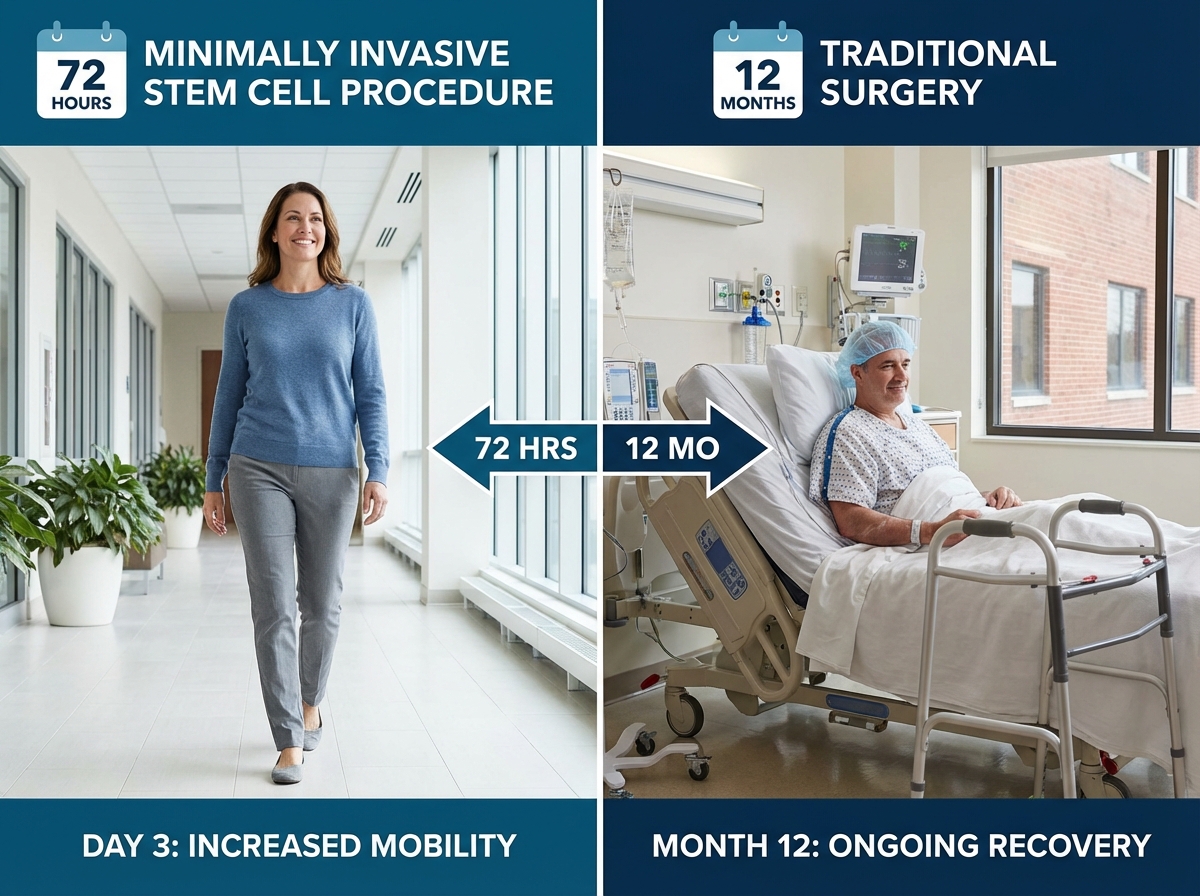
Picture this scenario: two patients with similar knee osteoarthritis receive treatment on the same Monday morning. By Thursday, one patient has returned to work, attended their child’s soccer game, and resumed most daily activities. The other patient remains in a hospital bed, managing post-operative pain and learning to navigate with a walker. This stark contrast represents the fundamental difference between stem cell injection recovery time and traditional orthopedic surgery recovery.
The question facing millions of Americans dealing with joint pain, sports injuries, and degenerative conditions is not simply which treatment works better—it’s how each option affects the months of life that follow. This comprehensive comparison examines recovery timelines at seven key intervals: 24 hours, 72 hours, one week, four weeks, three months, six months, and twelve months post-treatment.
The concept of “opportunity cost” proves essential to understanding this comparison. Recovery time represents more than healing—it encompasses work productivity, family engagement, recreational pursuits, and overall quality of life. While both stem cell therapy and surgery may require six to twelve months to achieve full results, the day-to-day experience during that period differs dramatically.
Understanding the Recovery Timeline Framework
Recovery means fundamentally different things for stem cell injections versus surgical interventions. For stem cell patients, recovery focuses on optimizing the regenerative process and returning to normal activities. For surgical patients, recovery involves healing from tissue trauma, managing wounds, and rebuilding strength lost during immobilization.
Stem cell injection recovery operates on an entirely different biological principle. Without surgical incisions, tissue trauma, or general anesthesia, the body does not need to heal from the treatment itself. Instead, the recovery period centers on allowing stem cells to perform their regenerative work undisturbed.
Research indicates that stem cells remain dynamically active for approximately ten weeks post-injection, continuously promoting healing throughout this period. Initial pain relief typically begins between two and twelve weeks after treatment, with peak healing occurring at three to six months. Benefits commonly last six to twenty-four months or longer, with some patients reporting relief extending two to three years from a single treatment session.
The recovery phases for stem cell therapy focus on optimization rather than wound healing: weeks one through two involve inflammation management, weeks three through six encompass initial tissue repair, months two through three bring significant improvement, and months four through six represent long-term regeneration. Research suggests that many patients experience substantial and long-lasting relief, though individual outcomes vary.
The First 24 Hours: Walking Out vs. Waking Up
The immediate post-treatment experience reveals the most dramatic contrast between these two approaches.
Stem cell injection patients walk out of the procedure independently. They experience mild soreness comparable to post-workout stiffness, primarily at the injection site. Most can drive home (though some providers recommend a driver as a precaution) and perform light household tasks that same day. The procedure requires no hospital stay, no general anesthesia recovery, and no intensive monitoring.
Surgical patients spend these hours in a hospital recovery room. They manage post-anesthesia effects including nausea, grogginess, and disorientation. Significant pain requires medication management. Depending on the procedure, they may have incisions, drains, and catheters requiring attention. Weight-bearing is typically prohibited, and mobility is severely restricted.
This first day establishes the trajectory for everything that follows. One group loses a single day to a medical procedure; the other begins a journey of extended immobility and dependence.
72 Hours Post-Treatment: Returning to Routine vs. Beginning Recovery
By the 72-hour mark, the divergence becomes even more pronounced.
Stem cell patients in sedentary occupations typically return to work. They resume light daily activities, manage mild inflammation with ice, and avoid only anti-inflammatory medications (which could interfere with the regenerative process). Walking occurs normally with only minor restrictions.
Surgical patients remain in the hospital or have just been discharged. They learn to use mobility aids—crutches, walkers, or wheelchairs depending on the procedure. First post-operative appointments assess wound healing and check for complications. Prescription pain medications remain necessary, and even basic activities require assistance.
The economic implications become clear: stem cell patients maintain productivity and income, while surgical patients begin using sick leave or disability benefits. One group preserves normalcy; the other adjusts to significant lifestyle disruption.
One Week: Light Restrictions vs. Intensive Care Needs
At the one-week milestone, stem cell patients have essentially returned to normal life with modest limitations. They work full schedules, handle family responsibilities, and engage socially. The primary restrictions involve avoiding strenuous exercise and high-impact activities—essentially, skipping the gym while continuing everything else.
Surgical patients at one week are beginning physical therapy, managing wound care, and remaining dependent on mobility aids. Even basic tasks like showering, dressing, and meal preparation may require assistance. The contrast extends beyond physical limitations to social and family dynamics, where stem cell patients function independently while surgical patients need significant support.
Four Weeks: Resuming Activities vs. Early Rehabilitation
The four-week point represents a significant milestone for stem cell patients: clearance for normal activities and exercise. The initial tissue repair phase is well underway, and many patients report early signs of improvement. Return to gym workouts, recreational sports, and full physical activity becomes appropriate.
Surgical patients at four weeks remain in intensive physical therapy. Some may be transitioning off mobility aids, but significant limitations persist. The celebration at this stage involves walking unassisted—an activity stem cell patients never lost.
This milestone also marks the end of the anti-inflammatory medication restriction for stem cell patients, as the critical regenerative window has passed. Surgical patients, meanwhile, may still require pain management protocols.
Three Months: Experiencing Improvement vs. Mid-Recovery Milestones
At three months, stem cell patients enter their significant improvement phase. Noticeable pain relief and functional gains become apparent. Full activity has been maintained throughout, and quality of life remains high. The cumulative opportunity cost becomes striking: three months of work, activities, and life experiences preserved.
Surgical patients reach mid-recovery milestones at this point. Some activities may be cleared, but physical therapy continues. For many orthopedic procedures, this represents the average recovery midpoint—meaning equal time remains before full recovery.
Both groups experience improvement, but the context differs entirely. Stem cell patients optimize results while living normally; surgical patients regain baseline function they lost months earlier.
Six Months: Peak Healing vs. Approaching Full Recovery
The six-month mark represents peak healing for stem cell therapy. Long-term regeneration occurs, and maximum benefit manifests. Patients enjoy full, unrestricted activity and assess whether their treatment goals have been achieved.
Surgical patients approach full recovery for some procedures, though complex surgeries like spinal procedures or total joint replacements may still impose restrictions. Return to high-impact activities may just be receiving clearance—activities stem cell patients resumed five months earlier.
Clinical studies demonstrate improvements in pain and function extending upwards of 24 months post-stem cell treatment for conditions like knee osteoarthritis.
Twelve Months: Long-Term Benefits vs. Complete Recovery
At the one-year mark, stem cell patients enjoy sustained benefits well within the typical six to twenty-four month duration. Some report relief lasting two to three years from a single session. The year has been spent living normally, with treatment representing a minor interruption rather than a defining experience.
Surgical patients reach full recovery for most procedures at this point. Knee replacement recovery averages three to twelve months, meaning some patients are just completing rehabilitation. The year has been defined by recovery, therapy, and gradual return to function.
The opportunity cost totals become significant: approximately eleven months of normal productivity, family engagement, and recreational activity preserved with stem cell therapy versus spent recovering from surgery.
Factors That Influence Stem Cell Injection Recovery Time
Individual outcomes vary based on several factors:
- Patient characteristics: Age, inflammation levels, overall health status, and condition severity all influence recovery speed
- Treatment protocol: The specific therapy used (BMAC, PRP, exosomes) and injection site affect timelines
- Post-treatment compliance: Avoiding NSAIDs for four to six weeks and following activity restrictions proves critical for optimal results
- Condition specifics: Knee osteoarthritis, rotator cuff injuries, and spinal conditions each present unique recovery patterns
Some patients may require repeat treatments for optimal results, and individual response to stem cell therapy varies.
Occupation-Specific Return to Work Timelines
Return-to-work expectations vary by occupation type for stem cell patients:
- Desk jobs and sedentary work: 24-72 hours
- Light physical labor: Within one week with minor modifications
- Moderate physical demands: Two to four weeks
- Heavy labor and high-impact occupations: Four to six weeks before full duty clearance
The same occupations typically require six weeks to six months or more for surgical recovery, representing substantial economic impact.
Setting Realistic Expectations
Understanding the distinction between “return to activities” and “full recovery” proves essential. Stem cell patients return to normal life within days but may not experience maximum benefit for months. Both surgery and stem cells may take six to twelve months for optimal results—the critical difference lies in quality of life during that period.
Research on mesenchymal stem cell therapies shows varying success rates depending on the condition treated. Stem cell therapy is not appropriate for all conditions or patients, and severe structural damage may still require surgical intervention.
Important Regulatory Information: As of 2026, the FDA has not approved stem cell, PRP, or exosome products specifically for orthopedic conditions. However, substantial clinical evidence supports safety and efficacy when administered by qualified providers within FDA regulatory frameworks. Patients should discuss the investigational nature of these treatments with their healthcare provider.
Conclusion
The contrast between stem cell injection recovery and surgical recovery extends far beyond healing timelines. It encompasses months of work productivity, family engagement, recreational pursuits, and psychological well-being. While both treatments can achieve positive functional outcomes, the journey differs dramatically.
Stem cell injection recovery time represents not merely faster healing but months of life preserved. Clinical evidence demonstrates that many patients experience substantial benefit lasting six to twenty-four months, providing outcomes that merit serious consideration for appropriate candidates.
For individuals exploring alternatives to knee replacement surgery, Unicorn Bioscience offers comprehensive stem cell therapy consultations across eight locations in Texas, Florida, and New York. With virtual and in-person consultations available, same-day treatment for qualified candidates, and precision-guided injection technology, patients can evaluate whether their recovery goals can be achieved without months of surgical downtime. Contact (737) 347-0446 or visit unicornbioscience.com to schedule a consultation.
Schedule Your Consultation Today!