Regenerative Medicine Clinic Near Me Texas: The 6-City Access Map That Finds Your Nearest Unicorn Bioscience Location in 2026
Regenerative Medicine Clinic Near Me Texas: The 6-City Access Map That Finds Your Nearest Unicorn Bioscience Location in 2026
Introduction: The Texas Regenerative Medicine Access Problem and the Only Statewide Solution
Texas patients searching for a regenerative medicine clinic face a frustrating reality. The search query “regenerative medicine clinic near me Texas” typically returns single-city providers that cannot serve patients who relocate, travel for work, or need follow-up care in a different metro area. For a state spanning over 268,000 square miles, this geographic limitation creates a significant barrier to consistent, quality care.
The urgency of this access problem is amplified by the scale of musculoskeletal disorders affecting Americans. According to The Lancet Healthy Longevity (2025), musculoskeletal disease prevalence in the USA rose 21.71% from 2000 to 2021, with osteoarthritis affecting 31% of individuals over 55. By 2030, musculoskeletal disorders are projected to impair 78 million U.S. adults. Texas’s rapidly aging population and vast geographic spread make this challenge particularly acute.
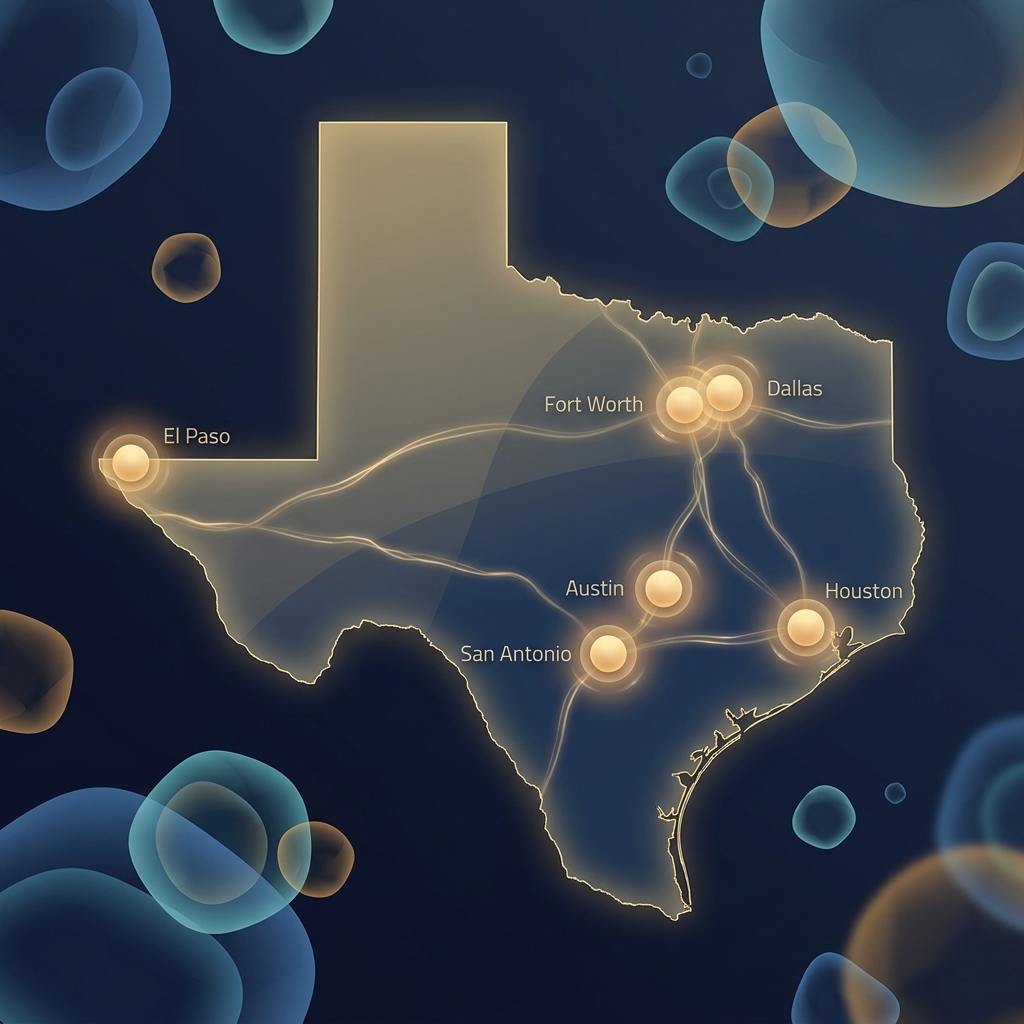
This article provides a statewide access map showing exactly which Unicorn Bioscience location serves each Texas metro and surrounding suburbs. More importantly, it explains the structural advantages of choosing a six-location Texas network over a single-city clinic.
The coverage gap thesis is straightforward: many Texas regenerative medicine providers operate from a single location. Unicorn Bioscience’s six-location Texas network follows the patient across the state, ensuring treatment records, protocols, and care continuity travel with them.
As of December 2025, Google removed AI Overviews from all “near me” healthcare searches, meaning this article and traditional local search results are the primary discovery pathway for high-intent Texas patients seeking regenerative care.
Why Texas Patients Are Searching for Regenerative Medicine Right Now
The demand for regenerative medicine in Texas reflects broader market dynamics. According to Fortune Business Insights, the global regenerative medicine market was valued at approximately $48 to $60 billion in 2025 and is projected to reach $58.40 billion in 2026. North America holds 43 to 49% of the global market share, with Texas positioned at the center of this growth.
The orthopedics and musculoskeletal segment dominates the field, accounting for approximately 33.4% of total regenerative medicine revenue. This directly validates why Texas patients are searching for these clinics in increasing numbers.
Texas demographics amplify the demand. Fort Worth crossed 1 million residents in 2025, with over 101,645 senior residents navigating aging joints. Houston anchors the Texas Medical Center, the largest medical complex on the planet, establishing the region as a global hub for medical innovation.
The surgery-avoidance driver is significant. Over 600,000 knee replacements are performed annually in the United States, yet studies suggest up to 80% of patients told they need total knee replacement may not actually require surgery. Regenerative medicine offers a credible alternative pathway for these patients.
Specialty clinics represent the fastest-growing end-user segment in regenerative medicine, projected at a 21.73 to 25.73% CAGR through 2031. Population aging has been identified as the key driver of increasing musculoskeletal disorder burden in approximately one-third of countries, directly validating demand for regenerative orthopedic clinics in Texas’s aging population.
Scientific momentum continues to build. A $140 million Phase III clinical trial for stem cell therapies in osteoarthritis was announced in January 2026, and 224 active global clinical trials are currently investigating stem cell therapies for osteoarthritis.
The 6-City Access Map: Every Unicorn Bioscience Texas Location and Who It Serves
Rather than a generic clinic directory, this section functions as a proximity navigator. It matches each Unicorn Bioscience location to its primary metro and the surrounding suburbs and communities it realistically serves.
All six Texas locations share the same treatment protocols, imaging-guided injection standards, and patient record systems. The nearest location is also the best location for continuity of care.
Houston: 12121 Richmond Ave., Suite #312, Serving the Greater Houston Metro
Address: 12121 Richmond Ave., Suite #312, Houston, TX 77082
Primary Service Area: Houston proper, Katy, Sugar Land, Pearland, The Woodlands, Cypress, Spring, Pasadena, and League City.
Houston stands as one of the most credible cities globally for regenerative medicine. The Texas Medical Center is the largest medical complex on the planet, and the Gulf Coast Consortia positions the TMC at the forefront of regenerative science nationally. The Texas Heart Institute at Baylor College of Medicine is a leader in regenerative medicine research, elevating the entire Houston medical ecosystem.
Virtual consultations are available for patients in outlying areas like Galveston, Conroe, or Beaumont who may want to pre-screen before driving in.
Dallas: 6200 Lyndon B. Johnson Fwy, Suite 180, Serving the DFW Metroplex (North and East)
Address: 6200 Lyndon B. Johnson Fwy Suite 180, Dallas, TX 75240
Primary Service Area: Dallas proper, Plano, Frisco, Richardson, Garland, Mesquite, Irving, Carrollton, and surrounding North Dallas suburbs.
Unicorn Bioscience’s advantage is network continuity. A Dallas patient who relocates to Houston or Austin does not lose their treatment history.
DFW patients in the eastern and northern suburbs are better served by the Dallas location, while western and southern DFW suburbs are better served by Fort Worth. Same-day treatment availability for qualified candidates is a key differentiator for high-intent Dallas patients who want immediate action after their consultation.
Fort Worth: 3712 W 7th St, Serving Western DFW and the Mid-Cities
Address: 3712 W 7th St, Fort Worth, TX 76107
Primary Service Area: Fort Worth, Arlington, Grand Prairie, Mansfield, Burleson, Weatherford, Cleburne, and the Mid-Cities corridor including Hurst, Euless, Bedford, Grapevine, Southlake, and Keller.
Fort Worth crossed 1 million residents in 2025, becoming the 11th-largest U.S. city, with over 101,645 senior residents navigating aging joints and degenerative conditions. This represents a direct and growing demand base for regenerative orthopedic care.
Patients west of I-35W are generally closer to the Fort Worth location; patients east of I-35E are generally closer to Dallas. Both locations share the same network, so treatment records are fully portable between them.
Austin: 2501 W William Cannon Dr, STE 208, Serving the Austin Metro and Central Texas
Address: 2501 W William Cannon Dr STE 208, Austin, TX 78745
Primary Service Area: Austin proper, Round Rock, Cedar Park, Georgetown, Pflugerville, Kyle, Buda, San Marcos, and the broader Central Texas corridor.
Austin’s demographics skew younger and more athletically active than other Texas metros. This makes sports injury recovery, ligament and tendon repair, and PRP therapy particularly relevant treatment angles for this location.
The South Austin location is strategically accessible for patients coming from Kyle, Buda, and San Marcos to the south, as well as central Austin. Patients in San Marcos or New Braunfels can choose either the Austin or San Antonio location based on proximity, and their records travel seamlessly between both.
San Antonio: 115 Gallery Cir, Suite 101, Serving the Alamo City and South Texas
Address: 115 Gallery Cir Suite 101, San Antonio, TX 78258
Primary Service Area: San Antonio proper (especially North SA and Stone Oak corridor), Boerne, Bulverde, New Braunfels, Schertz, Converse, and Universal City.
The Gallery Circle location is positioned in one of San Antonio’s most affluent and medically active northern corridors, easily accessible from the North SA suburbs most likely to have patients seeking non-surgical orthopedic alternatives.
San Antonio is the southernmost Unicorn Bioscience Texas location, making it the default choice for patients in Laredo, Corpus Christi, and the Rio Grande Valley who are willing to travel for specialized regenerative care. More than 90% of Unicorn Bioscience stem cell patients have not gone on to knee replacement surgery, a compelling data point for San Antonio patients who have been told they need joint replacement.
El Paso: 11240 Vista Del Sol, Suite C, Serving West Texas and the Borderplex
Address: 11240 Vista Del Sol Suite C, El Paso, TX 79936
Primary Service Area: El Paso proper, Las Cruces (NM), Horizon City, Socorro, and the broader Borderplex region.
El Paso is the only major Texas metro with a dedicated Unicorn Bioscience location in West Texas. Patients in this region who seek regenerative orthopedic care would otherwise need to travel to another major metro.
El Paso’s military presence at Fort Bliss creates a significant population of active-duty and veteran patients with orthopedic injuries who may be seeking non-surgical alternatives. An El Paso patient who relocates to Dallas or Houston for work retains their full treatment history and can continue care at the nearest location without starting over.
The Coverage Gap Problem: Why Single-City Providers Fall Short for Texas Patients
Many Texas regenerative medicine providers operate from a single location. For patients, this means that moving cities, traveling for work, or needing follow-up care in a different metro requires starting over with a new provider who has none of their treatment history.
Unicorn Bioscience’s statewide Texas network means treatment records, inflammation baselines, treatment protocols, imaging records, and response history travel with the patient across all six Texas locations.
The geographic reality of Texas makes this essential. A patient in El Paso is closer to Los Angeles than to Houston. A statewide network is not a luxury; it is a functional necessity.
Many Texas providers do not publish pricing, creating friction and distrust. Unicorn Bioscience addresses cost expectations transparently: PRP typically ranges from $500 to $2,000 per session, and stem cell therapy from $3,000 to $7,500 per treatment.
What the Multi-Location Network Means for Care: 4 Structural Advantages
1. Continuity of Care Across the State
Treatment for orthopedic conditions is rarely a single visit. PRP may require multiple sessions. Stem cell therapy involves follow-up assessments. Personalized protocols are refined over time based on patient response.
With a single-location provider, relocation or extended travel breaks the care continuum. With Unicorn Bioscience’s six-location Texas network, the same treatment team infrastructure and shared records system means care continues uninterrupted.
2. Treatment Records Portability
Regenerative medicine treatment outcomes depend heavily on baseline data: inflammation levels, imaging results, prior treatment responses, and medication history. When records are siloed at a single-location provider, a patient who needs care in a different city must rebuild this baseline from scratch.
Unicorn Bioscience’s shared network infrastructure means the treating provider at any Texas location has access to the full patient history, enabling personalized protocols from day one of any follow-up visit.
3. Same-Day Availability Across Six Markets
Qualified candidates can receive injection treatments on the same day as their consultation. With six Texas locations, same-day availability is not dependent on a single clinic’s schedule. This is particularly valuable for athletes and active individuals with acute injuries who need rapid intervention to minimize downtime.
4. Virtual Consultation as a Statewide On-Ramp
Patients anywhere in Texas can begin the process remotely, reviewing their condition, imaging, and medical history with a Unicorn Bioscience provider before committing to an in-person visit. This is especially valuable for patients in rural areas or patients with mobility limitations.
Approximately 82 to 89% of patients research providers online before booking, and 63% of healthcare searches lead to action within 72 hours. Virtual consultations capture this high-intent window before the patient books elsewhere.
Trust Signals: What High-Intent Patients Need to Know Before Booking
Credentials and Medical Team
Dr. Aldaas, CEO and Founder, is a board-certified physician with over a decade of experience in hospital medicine. He holds a medical degree from St. Matthew’s University School of Medicine, completed his residency in Family Medicine at Ellis Hospital, and served as Assistant Professor of Medicine at Albany Medical Center.
Josh Simpson, MS-PAC, serves as Technical Manager. He is a Physician Assistant with a Master’s degree, trained in Orthopedic Surgery at Johns Hopkins, with experience at Hospital for Special Surgery in orthopedic trauma.
All injections are administered using ultrasound and X-ray imaging guidance, ensuring accurate delivery to targeted treatment areas.
FDA Transparency: What the Regulations Actually Say in 2026
As of 2026, the FDA has not approved stem cell, PRP, or exosome products specifically for orthopedic conditions. These are classified as investigational. Treatments are administered within FDA regulatory frameworks by qualified providers.
The FDA has received nearly 370 RMAT designation requests and approved 184, with 13 RMAT-designated products now approved for marketing as of mid-2025. In July 2025, the FDA granted RMAT designation to Genascence’s GNSC-001, a first-in-class gene therapy for knee osteoarthritis.
Treatment Options Available at All Six Texas Locations
Core treatment modalities include Stem Cell Therapy, PRP (Platelet-Rich Plasma), BMAC (Bone Marrow Aspiration Concentrate), Exosome Therapy, Hyaluronic Acid Injections, and Peptide Therapy.
Body regions treated include shoulder, elbow, hand and wrist, spine and neck, hip, knee, ankle, and foot. Conditions treated include osteoarthritis, tendon injuries, ligament tears, rotator cuff injuries, meniscus injuries, and plantar fasciitis.
Cost Expectations and Payment Options
PRP typically ranges from $500 to $2,000 per session. Stem cell therapy ranges from $3,000 to $7,500 per treatment. Most private insurers and Medicare do not currently cover regenerative medicine treatments for orthopedic conditions. HSA and FSA funds may be applicable. Financing options may be available upon request.
What to Expect at the First Visit: The Unicorn Bioscience Patient Journey
Step 1: The process begins with a consultation (virtual or in-person) where the provider reviews the patient’s condition, imaging, medical history, current medications, and treatment goals.
Step 2: The provider evaluates candidacy based on inflammation levels, injury type, age, and health profile. Not every patient is a candidate.
Step 3: If the patient is a candidate, a customized protocol is developed, selecting the appropriate modality and treatment schedule.
Step 4: Qualified candidates can receive their first injection treatment on the same day as their consultation, using imaging-guided precision delivery.
Step 5: Outcomes are tracked over time, with follow-up visits to assess response and refine the protocol. Records are portable across all six Texas locations.
Are You a Candidate? A Self-Screening Guide for Texas Patients
Strong candidate indicators include:
- Joint pain that has not responded adequately to physical therapy or medication
- A diagnosis of osteoarthritis, tendon injury, ligament damage, or rotator cuff injury
- Recommendation for joint replacement surgery with desire to explore alternatives
- Active lifestyle with a desire to return to full function
- Not currently pregnant or managing active infection or cancer
Patients who have been told they need total knee replacement are a primary candidate group. Up to 80% of such patients may not actually require surgery.
Patients uncertain about their candidacy can use the virtual consultation pathway to get a professional assessment without committing to an in-person visit.
Conclusion: The Statewide Network Is the Standard, Find Your Nearest Location Today
For Texas patients searching for a regenerative medicine clinic, the question is not just which clinic is closest, but which clinic can serve them across the state, protect their treatment history, and deliver consistent care wherever they are.
Unicorn Bioscience operates a six-location regenerative medicine network across Texas: Houston, Dallas, Fort Worth, Austin, San Antonio, and El Paso.
With a $140 million Phase III clinical trial underway in 2026 and 224 active global clinical trials, regenerative medicine for orthopedic conditions is not a fringe offering. It is an evidence-based field at an inflection point. The FDA’s September 2025 draft guidance on expedited programs for regenerative medicine therapies reflects the growing regulatory maturity of this field.
For patients who have been told surgery is their only option, or who are living with joint pain that is limiting quality of life, a consultation with Unicorn Bioscience is a low-barrier, high-value first step.
Ready to Find Your Nearest Location? Book a Consultation with Unicorn Bioscience
Phone: (737) 347-0446
Website: unicornbioscience.com
Texas Locations:
- Houston: 12121 Richmond Ave., Suite #312, Houston, TX 77082
- Dallas: 6200 LBJ Fwy Suite 180, Dallas, TX 75240
- Fort Worth: 3712 W 7th St, Fort Worth, TX 76107
- Austin: 2501 W William Cannon Dr STE 208, Austin, TX 78745
- San Antonio: 115 Gallery Cir Suite 101, San Antonio, TX 78258
- El Paso: 11240 Vista Del Sol Suite C, El Paso, TX 79936
Virtual consultations are available for patients who want to assess candidacy before visiting in person. Same-day treatment is available for qualified candidates. The sooner a consultation is scheduled, the sooner patients can begin their path to recovery without surgery.
Schedule Your Consultation Today!